

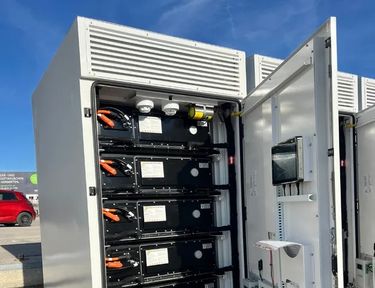
How Battery Storage Supports EV Charging Hubs with Limited Grid Capacity
The rapid growth of electric mobility is accelerating the deployment of high-power EV charging infrastructure. For commercial fleets, logistics operators, and charging hub developers, providing reliable fast charging is becoming increasingly important.
However, many locations face a common challenge: the available grid connection capacity is often insufficient to support multiple high-power chargers operating at the same time.
Increasing grid capacity can require significant investment, lengthy approval procedures, and additional infrastructure work.
Battery storage for EV charging provides an effective solution by allowing businesses to make better use of existing grid capacity, reduce peak demand, and enable high-power charging without immediate grid expansion.
Why Is Battery Storage Becoming Important for EV Charging Hubs?
The transition from conventional vehicles to electric fleets is changing the requirements for commercial energy infrastructure.
Unlike traditional refueling, electric vehicle charging depends directly on available electrical capacity. As more companies adopt electric vehicles and electric trucks, charging sites must handle higher power demand within shorter periods.
This challenge is particularly significant for electric truck charging. Fleet vehicles often have limited dwell times at operational sites, meaning charging systems must deliver sufficient power within a short timeframe.
In many cases, the required charging power is significantly higher than the available grid connection capacity.
For example, a logistics company may install several high-power charging stations capable of delivering hundreds of kilowatts. However, the existing grid connection may not provide enough power to operate all chargers at their full capacity simultaneously.
A grid upgrade can solve this limitation, but it may involve high costs, long approval processes, and additional infrastructure requirements. Battery storage offers an alternative approach by providing additional power when charging demand exceeds available grid supply.
How Does Battery Storage Optimize EV Charging Infrastructure?
A battery storage system for an EV charging hub acts as an energy buffer between the grid, renewable energy sources, and charging stations.
Instead of requiring the grid to supply the entire charging load during peak periods, the battery system can provide additional power when demand increases. This allows charging operators to improve the utilization of existing grid connections and avoid unnecessary infrastructure expansion.
Peak Shaving for EV Charging Hubs
One of the most important applications of battery storage is peak shaving.
During periods of high charging demand, the battery storage system supplies additional power and reduces the maximum load drawn from the grid.
For commercial charging projects, this is especially valuable when multiple electric vehicles or trucks need to charge simultaneously but the available grid capacity is limited.
By reducing peak demand, battery storage helps businesses operate high-power charging infrastructure more efficiently while maintaining grid limitations.
The Role of EMS in Intelligent Charging Management
Battery storage provides additional energy flexibility, while an Energy Management System (EMS) controls how energy flows across the charging infrastructure.
The EMS continuously coordinates the interaction between the grid, solar PV system, battery storage, and charging stations. Based on charging demand, solar generation, battery status, and grid limitations, it determines the most efficient way to distribute available power.
For example, solar energy can be used directly for vehicle charging during the day, excess PV generation can be stored for later use, and battery power can support charging during periods when grid demand reaches its limit.
With intelligent energy management, battery storage becomes an important part of a flexible and scalable EV charging infrastructure.
Case Study: Battery Storage for Electric Truck Charging in Alheim, Germany
A practical example of battery storage supporting commercial EV charging infrastructure can be seen in Alheim, Germany.
At a logistics company site, a charging solution was developed to support the electrification of its truck fleet.
The company operates multiple electric trucks with limited dwell times at the site, making reliable and fast charging essential. The objective of the project was to provide high-power charging capability without requiring a major expansion of the existing grid connection.
System Configuration
| Component | Specification |
|---|---|
| Solar PV system | 600 kWp |
| ABB charging stations | 2 × 400 kW |
| Battery storage system | 261 kWh |
| Maximum grid import capacity | 160 kW |
Challenge: High Charging Demand with Limited Grid Capacity
The installed charging infrastructure could provide significantly higher charging power than the available grid connection.
Although two ABB charging stations with a rated power of 400 kW each were installed, the site was limited to a maximum grid import capacity of only 160 kW.
Without additional power support, the available grid capacity would have restricted charging speed and reduced the operational flexibility of the electric truck fleet.
The key challenge was to enable fast electric truck charging while working within the existing grid limitations.
Solution: Battery Storage Combined with Intelligent Energy Management
To overcome the grid limitation, a 261 kWh battery storage system was integrated into the charging infrastructure.
The system combines solar PV generation, battery storage, EV charging stations, and intelligent EMS control.
During charging operations, energy can be supplied from solar generation, stored battery energy, or the available grid connection depending on real-time conditions.
The EMS dynamically manages power distribution and determines how charging power is allocated based on vehicle requirements, renewable energy availability, battery status, and grid limits.
This approach allows the site to increase charging capability without relying solely on costly grid expansion.
Project Benefits: Maximizing Existing Energy Infrastructure
The Alheim project demonstrates how battery storage can support commercial EV charging applications where grid capacity is limited.
By combining battery storage with intelligent energy management, the system enables high-power charging while making better use of existing infrastructure. It also allows renewable energy from the PV system to be integrated more effectively into daily charging operations.
This approach provides businesses with greater flexibility when expanding EV charging infrastructure for future fleet electrification.
Learn more:
→ Alheim EV charging hub project with battery storage
→ UltiBlock TL261 battery storage system for commercial applications
Battery Storage Sizing and Cost Considerations for EV Charging Hubs
The cost and size of a battery storage system for an EV charging hub depend on the specific requirements of each project. Key factors include charging demand, available grid capacity, vehicle usage patterns, PV integration, and EMS requirements.
Battery storage sizing is not determined only by the number of charging points. The most important factor is the difference between the available grid capacity and the required charging power. When charging demand exceeds the available grid connection capacity, the battery system provides additional power to support peak charging periods.
A professional system design considers both battery power output (kW) and energy capacity (kWh), while also taking into account future fleet expansion and operational requirements. For businesses evaluating whether battery storage is suitable for their charging infrastructure, understanding when battery storage is worthwhile for EV charging parks is an important first step.
FAQ: Battery Storage for EV Charging Hubs
How do you size battery storage for an EV charging hub?
Battery storage sizing depends on charging requirements, grid connection capacity, vehicle charging patterns, and operational goals. Both battery power output (kW) and energy capacity (kWh) need to be considered.
How much does battery storage for an EV charging hub cost?
The cost depends on battery capacity, power rating, EMS integration, charging requirements, and project conditions. A customized system assessment is required to determine the most suitable solution.
Can battery storage replace a grid upgrade for EV charging?
Battery storage does not always replace grid expansion. However, it can reduce the required grid capacity by managing peak demand and improving the utilization of existing infrastructure.
How does peak shaving work in an EV charging hub?
Peak shaving uses battery storage to provide additional power during periods of high demand, reducing the maximum power drawn from the grid connection.
What role does an EMS play in EV charging infrastructure?
An EMS optimizes energy flows between the grid, PV system, battery storage, and charging stations. It ensures that available power is distributed efficiently while maintaining grid limits.
Conclusion: Battery Storage Enables Flexible EV Charging Infrastructure
As electric vehicle adoption continues to grow, grid capacity has become a key factor influencing the development of commercial charging infrastructure.
Battery storage enables businesses to maximize existing grid connections, support high-power charging, and reduce dependence on costly grid upgrades.
By integrating battery storage, EMS, and renewable energy, companies can build more flexible, efficient, and scalable EV charging infrastructure for future fleet electrification.
Plan an EV Charging Hub with Battery Storage?
Ultimati Energie supports businesses, installers, and EPC partners with battery storage system design, integration, and commercial energy storage solutions.
Request a free battery storage assessment for your EV charging project.

Ultimati Energie Deutschland GmbH est un fournisseur allemand de systèmes de stockage d'énergie B2B spécialisé dans les solutions de stockage par batterie évolutives pour les secteurs résidentiel et commercial et industriel, destinées à ses partenaires européens.
Devenez partenaire
Ventes : +49 1624886367
Service client :
+49 15226994869
Adresse : Ober der Röth 4, 65824 Schwalbach am Taunus, Allemagne
Copyright © 2026 Ultimati Energie Deutschland GmbH Tous droits réservés.